Build Games Visually
Keep Native Control
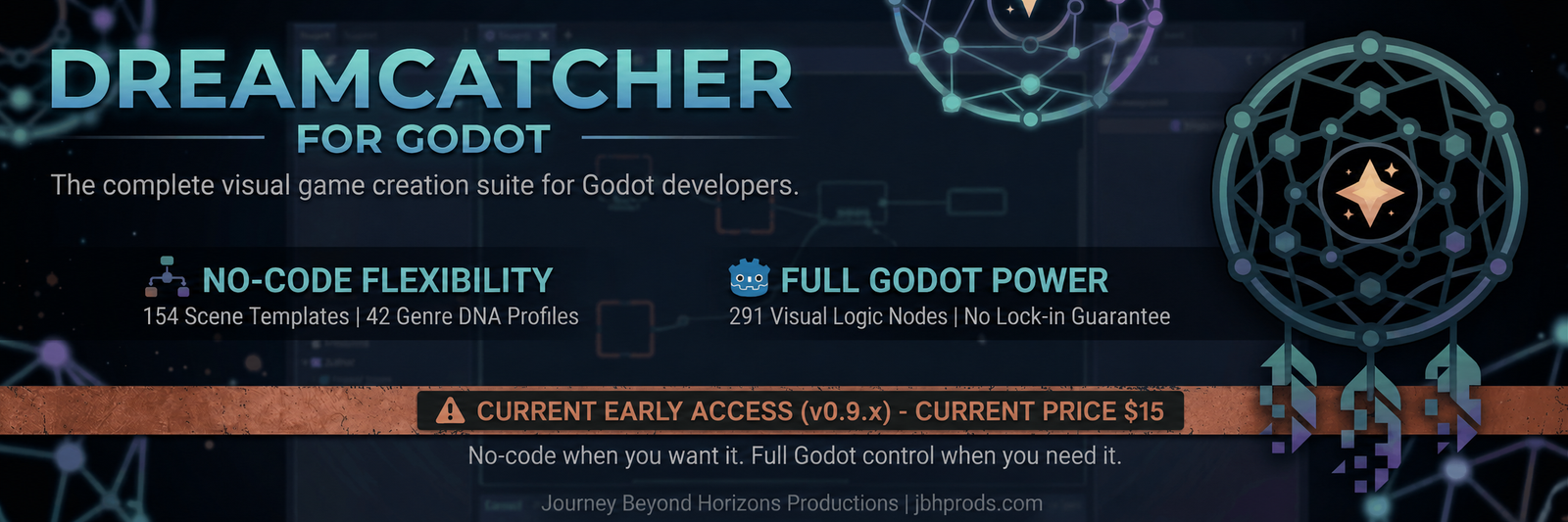
Dreamcatcher is a Godot-native visual creation suite for editable project content, generated assets, maps, UI, narrative, and validation. The new opt-in Workflow Bindings layer connects supported UI, audio, VFX, animation-event, accessibility/localization, and generated-asset runtime workflows while keeping your project open, inspectable, and under your control.
Current package: Dreamcatcher v0.9.5 Early Access — Game Feel + Workflow Integration. Buy once, keep all v1-generation updates, and choose this checkout or Itch.io.
# Dreamcatcher: zero code needed, but scripting stays available:# Play background musicDreamAudio.play_bgm("res://music/adventure.ogg")# Give the player a swordDreamCore.add_item("Iron Sword", 1)# Start a questDreamCore.start_quest("rescue_the_village")# Transition to the dungeon scene with a fadeDreamSceneManager.go_to("res://scenes/dungeon.tscn")# Save the gameDreamSave.save_game(0) # slot 0Guided Walkthrough
The written overview and preview gallery are available now. Video walkthroughs and expanded screenshots are coming soon for public visitors.
6 Tool Views. One Workspace.
Dreamcatcher lives entirely inside the Godot editor. The screenshots below highlight key workspace views, while the full toolkit now includes 24 featured editor tools.


A Visual Toolkit for Building Godot Games Faster
A focused Godot-native workflow for visual authoring, generated project content, editable maps, map events, validation, runtime helpers, and optional Classic 48×48 layout import: with clear Early Access scope.
Visual Logic System
291 visual logic node scripts across genre-aware systems. Build movement, combat, dialogue, inventory, behavior, and progression visually, while still keeping GDScript access when you want deeper control.
Scene Composer
154 unique scene templates across broad 2D, 3D, UI, genre, and workflow groups. Templates create inspectable Godot scenes and remain part of the normal project tree instead of becoming a locked proprietary format.
42 Genre DNA Profiles
The Genre DNA system configures the workspace for your game type. Platformer, RPG, Horror, Racing, Fighting, Visual Novel, Tower Defense, Roguelike, City Builder, Tactical RPG, Creature Collector, and FPS / Shooter Foundations. Switch any time.
Database & Progression Workflows
Create and manage typed game data for items, skills, enemies, shops, quests, recipes, regions, equipment, loot, and progression systems as editable Godot resources connected to validation and generated outputs.
Generated Asset Pipeline
v0.9.5 keeps the registry/metadata pipeline and adds explicit Bind to Runtime promotion so supported generated outputs can become validated runtime bindings without changing existing v0.9.4 assignment meanings.
Generated Assets Browser
Inspect, validate, manage, and revisit generated outputs, then explicitly promote supported content with Bind to Runtime. Runtime Bound remains separate from Assign/Apply and is written only after successful persistence and validation.
Runtime Building Blocks
Actors, triggers, pickups, cameras, transitions, weather, screen effects, input helpers, achievements, pooling, map reveal, runtime themes, and other gameplay helpers.
Map Events & Interactions
Create page-based map events, conditions, transfers, NPCs, chests, triggers, and interaction flows that stay connected to editable Godot map content.
Classic 48×48 Layout Import
Prepare familiar 48×48 tilesheet layouts for Godot-native TileSet and metadata workflows using assets you created, own, or are licensed to use.
UI Builder
Design interfaces visually, then create project-owned v0.9.5 screen recipes and runtime bindings for supported HUD, menu, inventory, quest, and dialogue workflows. Existing UI remains valid and activation stays explicit.
Narrative Weaver
Visual dialogue and story editor with 59 node types across 10 categories. Type in prose, convert to graph, or convert graphs back to readable text.
Combat System
12 unified combat modes through DreamCombatBridge: real-time action, turn-based, ATB, tactics, card battle, fighting, SHMUP, tower defense, roguelike, and more through one consistent layer.
Save System
Encrypted .dream save files with subsystem snapshots, thumbnails, corruption guards, backup rotation, and JSON debug export. Reliable one-call save and load support.
Export Readiness Checks
Review missing references and v0.9.5 binding readiness for UI recipes, semantic audio/VFX, animation events, generated-runtime metadata, accessibility/localization, and Godot export dependencies.
Behavior & Game-Feel Tools
Dynamic difficulty, mercy systems, threat assessment, group commands, pacing, behavior trees, FSMs, GOAP, and utility-style behavior graphs for richer gameplay flow.
Networking Foundations
DreamNetSync and local multiplayer systems are included as Early Access foundations. Production multiplayer projects should validate authority, hosting, latency, and export constraints per game.
Accessibility
Use font scaling, contrast/colorblind options, reduced motion, subtitles/TTS foundations, plus native Control accessibility metadata, localizable accessible text, focus/navigation validation, and reduced-motion-aware UI/VFX workflows.
Open Godot Workflow
Use Dreamcatcher visually, then extend deeper systems through Godot scenes, resources, GDScript, custom nodes, Dream Packs, and Architect Mode when needed.
24 Featured Editor Tools
A curated view of Dreamcatcher’s editor workspace, covering authoring, design, generation, generated asset management, AI-assisted guidance, conversion, validation, and project management.
Almanac
Central editor workspace
Visual Logic
Node-based scripting
Scene Composer
154 scene templates
UI Builder
Visual UI + runtime recipes/bindings
Narrative Weaver
59 dialogue node types
Map Editor
TileMapLayer maps, events, regions
Animation Studio
Animation markers & runtime events
Sound Studio
Audio creation + semantic event maps
Cinematic Editor
16 track timeline
Sketch Enhancer
Pixel art, 9 tools
Gameplay Director
9 guided content generators
Ideation Board
Game design organizer
Procedural Toolkit
12 procedural generators
Generated Asset Browser
Registry, validation & Bind to Runtime
AI Dream Advisor
Built-in help + optional AI providers
Database
Resource browser & editor
Content Validator
Content + binding readiness checks
Asset Pipeline
Import & batch processing
Performance Panel
Per-system diagnostics
Module Manager
Toggle genre modules
Migration Assistant
Reviewed migration & binding promotion
Bake Manager
Convert to native Godot
Asset Cleaner
Remove unused files
Export Manager
Preflight and platform guidance
42 Genre DNA Profiles. One Toolkit.
Select a profile to shape the starting workspace: logic palette, scene templates, combat mode, UI presets, runtime managers, validation hints, and starter workflows. Universal mode still supports hybrids and custom workflows.
DNA profiles combine editor presets, module visibility, starter workflows, and validation hints. Some advanced profiles, including FPS / Shooter Foundations and Creature Collector, are Early Access foundations and may require custom setup.
Your First Test Scene in Minutes
Four simple steps from plugin install to your first validated test scene. No-code workflows first, native Godot control when you need it.
Install the Plugin
Copy addons/dreamcatcher/ into your Godot project and enable it in Project Settings.
Pick Your Genre
The Welcome Wizard launches automatically and guides you through genre selection. The workspace, nodes, and templates adapt instantly.
Build Visually
Use Scene Composer for levels, Visual Logic for mechanics, Narrative Weaver for dialogue, UI Builder for menus, and generated asset tools for reusable project content.
Quick Play, Validate & Export-Preflight
Use Quick Play to test faster, run validation and export-preflight checks, then build through Godot’s standard export workflow with clear platform guidance.
What’s Included
One purchase, one plugin, and all v1-generation updates included. Some workflows are still Early Access and continue to mature through the roadmap.
29 Autoload Singletons
Core runtime services plus the opt-in DreamBindings coordinator; module/no-autoload deployment remains architecturally available.
116 Custom Node Types
Registered runtime, UI, gameplay, genre, and binding nodes, including DreamUIRuntimeBinder, DreamAnimationEventReceiver, and DreamSpriteFrameEventPlayer.
57 Resource Scripts
Typed game data plus v0.9.5 binding profiles, UI recipes/bindings, semantic audio/VFX maps, animation events, generated metadata, map events, quests, items, enemies, skills, and more.
15 ECS Traits
Health, Stats, Movement, Inventory, Equipment, Leveling, and composable actor components
12 Procedural Generators
Maps, worlds, sprites, icons, SFX, music, 3D shapes, names, loot, palettes, particles, isometric
11 Languages Built In
EN, ES, FR, DE, IT, PT, JA, KO, ZH, RU, AR, including RTL support
Expanded Validation & Release Gates
Content Validator covers Workflow Bindings, UI recipes, semantic audio/VFX, animation events, accessibility/localization, generated-runtime metadata, and export readiness; exact-build live verification remains separate.
Asset Import Guidance
Clear notes explain compatible asset workflows, layout preparation, and user-owned or licensed asset usage.
Progression & Adventure Systems
Quest Manager, Crafting, Shop, Inventory, Equipment, Leveling, Achievements, and Journal
World Systems
Dynamic weather, day/night cycle, minimap, fog of war, physics layers, and object pooling
4 Converters
Image, Audio, 2D-to-3D, and 3D-to-2D converters built into the Almanac
Debug Console
Runtime console with commands for vars, entities, services, perf, timescale, and more
Built Around Native Godot Workflows
Dreamcatcher is designed to help you create project-owned content, keep readable files, and avoid unnecessary lock-in.
Project-Owned Output
Generated content is designed to live in your Godot project folders, not inside a hidden external service or cloud-only workspace.
Readable Godot Files
Dreamcatcher focuses on standard Godot-friendly resources such as scenes, resources, TileSets, metadata, and validation reports.
Bake-Oriented Workflow
Bake and export-preflight tools help turn Dreamcatcher-authored content into more portable Godot project content where supported.
Offline Core Workflows
Core editor workflows are designed to run locally in Godot without requiring a mandatory online account for day-to-day creation.
Extensible Source
Advanced users can inspect and extend GDScript systems instead of being trapped behind a black-box editor.
Validation First
Validators, reports, and readiness checks help catch missing paths, broken references, and incomplete generated content.
Asset Import & Godot Workflows
Bring your own compatible tilesheets and asset packs into editable Godot-native workflows.
Built for Godot Creators
Dreamcatcher is developed by Journey Beyond Horizons Productions / JBH PRODS for creators building inside Godot.
Flexible TileSet Sources
Import generic Godot atlas images, custom-grid sheets, and compatible Classic 48×48 layouts into editable TileSet workflows instead of locking your project into one asset format.
Workflow Bindings
Opt-in project-owned binding profiles connect supported UI recipes, semantic audio/VFX maps, animation events, generated-asset runtime promotion, accessibility/localization, validation, and monitoring without auto-wiring arbitrary architectures.
Terrain, Collision & Navigation Hints
Imported tiles can carry role metadata, terrain scaffolding, animation hints, collision candidates, navigation candidates, and validation warnings for safer review inside Godot.
Godot-Native Output
Convert compatible sheets into editable Godot resources, metadata, and project-ready files.
Use Your Own Assets
Import assets you created, own, or are licensed to use.
Secure the Early Access Price
Early Access pricing is lower while Dreamcatcher continues toward v1.0. Buy during the current v0.9.5 stage to keep the lower v1-generation price.
Pricing Roadmap
Secure your price now before future public tiers increase with the release stage.
- Full plugin with 24 featured editor tools
- 42 Genre DNA Profiles with dedicated runtime managers, starter workflows, and validation hints
- 291 visual logic node scripts and 154 scene templates
- Typed game resources, generated asset metadata, map events, regions, presets, reports, and extension points
- Combat/RPG systems, runtime building blocks, networking foundations, and genre workflows in Early Access
- Export preflight and Godot standard export workflow guidance
- Documentation, quick-start notes, and included demos
- Accessibility and localization support
- All updates through the v1 generation included
- Clear future upgrade policy if a major v2 generation is ever announced
Prefer not to use the standard checkout? You can purchase it from its itch.io page.
Open the Itch.io PageCurrent package: Dreamcatcher v0.9.5 Early Access — Game Feel + Workflow Integration. No fixed v0.9.5 public-release date is stated here unless one is published separately. The current $15 Early Access tier is planned to increase at the Beta, RC, Stable launch, and later v1.x maturity stages.
Roadmap windows after the current v0.9.5 stage are planning targets and may shift based on testing, Godot compatibility, customer feedback, and release quality.
Digital product policy: refunds are reviewed fairly on a case-by-case basis for valid issues such as accidental purchase, duplicate purchase, or genuine blocking problems reported within 7 days.
Join the Community
Dreamcatcher is actively developed and supported. Connect with other creators building games with the toolkit.
What’s New in Dreamcatcher v0.9.5
v0.9.5 focuses on Game Feel + Workflow Integration: explicit project-owned connections between supported UI, audio, VFX, animation events, accessibility/localization, generated assets, validation, migration, monitoring, and export readiness while preserving existing v0.9.4 behavior by default.
DreamBindings coordinates project-owned binding profiles. Updating from v0.9.4 does not activate a profile, promote generated assets, change legacy skill timing, or replace existing runtime behavior by itself.
Supported HUD, menu, inventory, quest, and dialogue recipes can bind values, visibility, actions, localized text, repeated lists, focus behavior, and accessibility metadata through Dreamcatcher’s supported runtime paths.
Map supported UI, pickup, door/chest/reward, quest, battle/combat, region, weather, dialogue, and custom dotted semantic events to project-owned audio event resources with qualifiers, variants, cooldown/concurrency, scope, and 2D/3D/global playback options.
Semantic VFX events support 2D/3D/UI/AUTO space, source/target/socket attachment, pooling, lifecycle limits, reduced-motion alternatives, and generated VFX wrapper promotion for supported spawnable content.
Animation event resources support SFX, VFX, hitbox enable/disable, footsteps, camera shake, screen flash, gameplay, and UI events. Authored DreamSkill/BattleManager timing remains opt-in so legacy timing stays authoritative until explicitly enabled.
UI recipes can author native Control accessibility metadata and focus behavior. DreamLocalization now synchronizes with Godot TranslationServer while retaining fallback tables, with pseudolocalization, RTL, reduced-motion, and localization validation workflows.
The established Assign/Apply workflow remains separate. Supported generated outputs can be explicitly promoted into project-owned runtime binding resources; Runtime Bound is committed only after persistence and validation succeed.
Migration Assistant supports reviewed dry-run/selected-batch binding promotion, Content Validator checks binding-specific readiness, Event Monitor can expose opt-in binding telemetry, and export readiness catches supported unresolved binding problems.
v0.9.5 includes first-install parser/bootstrap hardening and editor file/save/import lifecycle improvements for the package’s supported workflows, including Sound Studio and generated-audio persistence paths.
Dreamcatcher v0.9.5 targets Godot 4.6–4.7, with Godot 4.7.1 recommended. Exact build-level validation remains documented in the technical QA matrix.
Learning Resources
Short, practical resources in the safest public order: install, build one playable scene, complete one full loop, learn generated assets and the browser, edit maps, connect no-code events, and check export readiness.
Quick Start Notes
Install the plugin, enable it in Godot, open the main dock, and create your first test scene with a simple step-by-step guide.
First Playable Test Scene
Build the smallest useful result: one room, one object or NPC, one interaction, validation, and playtest.
First Full Game Loop
Connect player action, trigger, condition, action, feedback, state, and testing into one safe first loop.
Generated Asset Workflow
Generate one asset, inspect metadata, preview it, validate it, apply or assign it, and save it safely.
Workflow Bindings
Connect supported HUD/UI, semantic audio/VFX, animation-event, accessibility/localization, and generated-asset runtime workflows through an explicit project-owned binding profile.
Editable Map Workflow
Turn generated maps into editable Godot content with layers, regions, events, validation, and next actions.
No-Code Logic & Events
Learn the beginner logic pattern: trigger, condition, action, feedback, state, and test.
Export Preflight
Review export readiness before building, while keeping Godot/platform requirements clear.
Resource formats are intentionally practical: setup and reference pages work best as written guides, while workflows and playable examples are better as short walkthroughs or checklists. The full manual remains available from the Learning Center for users who want every section in one place.
Public Roadmap & Update History
A clear customer-facing view of the release path: v0.9.0 launched publicly on March 10, 2026, v0.9.4 launched publicly on June 30, 2026, v0.9.5 launched publicly on August 12, 2026, v0.9.1–v0.9.3 were under-the-hood development update milestones, and future versions are shown as planned milestones without promised dates.
From Early Access foundation to stable release
The roadmap is written for buyers and creators: it separates current Early Access value, completed releases, planned improvements, beta, release candidate, and stable readiness.
Public history: v0.9.0 launched on March 10, 2026, v0.9.4 launched on June 30, 2026, and v0.9.5 launched on August 12, 2026. v0.9.1–v0.9.3 were reliability update notes between those public releases. Future milestones are planned directions and may change based on testing, Godot compatibility, customer feedback, and release quality.
Frequently Asked Questions
Answers to common questions about Dreamcatcher, its features, and usage.
No. Dreamcatcher is designed for visual creation first. You can use Visual Logic, Plain English mode, scene templates, and integrated tools without writing scripts. If you know GDScript, Architect Mode and Godot’s normal project structure let you extend deeper systems when needed.
Yes. Buying during Early Access secures your current v1-generation tier. You receive all future v1 updates without paying again. If Dreamcatcher ever moves beyond the v1 generation, future upgrade policies will be announced clearly.
Dreamcatcher v0.9.5 targets Godot 4.6–4.7, with Godot 4.7.1 recommended. The technical QA matrix retains the exact validation builds.
Yes. v0.9.5 is additive and opt-in. Updating from v0.9.4 does not activate a binding profile, promote assets, switch legacy skill timing, or replace existing region/audio behavior. Enable only the supported v0.9.5 connections you want.
Dreamcatcher creates standard Godot .tscn and .tres outputs where applicable, but projects that use Dreamcatcher runtime scripts or custom nodes should keep the addon installed or bake/export/replace those dependencies before removal.
Yes. Dreamcatcher is written in GDScript and can coexist with your C#/.NET project through Godot’s normal interoperability. Dreamcatcher v0.9.5 targets Godot 4.6–4.7, with Godot 4.7.1 recommended; validate your own .NET project and export targets.
Dreamcatcher includes networking and local-multiplayer foundations, but multiplayer projects still need careful testing for authority, hosting, latency, platform exports, and game-specific edge cases. Treat online multiplayer as an Early Access workflow, not an instant production guarantee.
A wide range of genres. The 42 Genre DNA Profiles cover Action RPG, Platformer, Visual Novel, Fighting, Racing, Horror, Tower Defense, Roguelike, Rhythm, City Builder, Tactical RPG, Creature Collector, and FPS / Shooter Foundations. Universal mode covers hybrids and custom workflows.
Yes. Dreamcatcher keeps service/module boundaries and custom-service/no-autoload deployment paths. Supported Workflow Bindings can connect Dreamcatcher semantics without custom glue for those supported workflows, while custom architectures outside the supported contracts are integrated explicitly rather than guessed.
Yes. Dreamcatcher is developed by Journey Beyond Horizons Productions / JBH PRODS as an independent Godot-native creation suite.
Yes. Dreamcatcher includes Classic 48×48 layout profiles and flexible import guidance for compatible user-provided tilesheets. Use assets you created, own, or are licensed to use; Dreamcatcher does not include or grant rights to third-party proprietary artwork, default assets, sample projects, editor code, runtime code, or asset packs from other engines or tools.
No. Core Dreamcatcher workflows do not require external AI services. Dream Advisor can use built-in guidance by default, with optional provider-backed assistance controlled by the user’s own settings.
Dreamcatcher reviews project readiness before Godot export. v0.9.5 adds binding-specific checks for UI recipes, semantic audio/VFX, animation events, generated-runtime metadata, accessibility/localization, and unresolved resources. It does not replace Godot export templates, platform SDKs, signing, store requirements, or target-platform testing.
Yes. Because Dreamcatcher is a digital product, refunds are reviewed fairly on a case-by-case basis. If you experience a genuine blocking issue, accidental purchase, duplicate purchase, or a problem that makes the product unusable as described, contact support within 7 days and your case can be reviewed.
Ready to Catch Your Dreams?
Secure the current v0.9.5 Early Access price tier and choose either checkout path: direct purchase here or Itch.io.